Car2Vec: compressing vehicle telemetry into 40 numbers for V2X networks
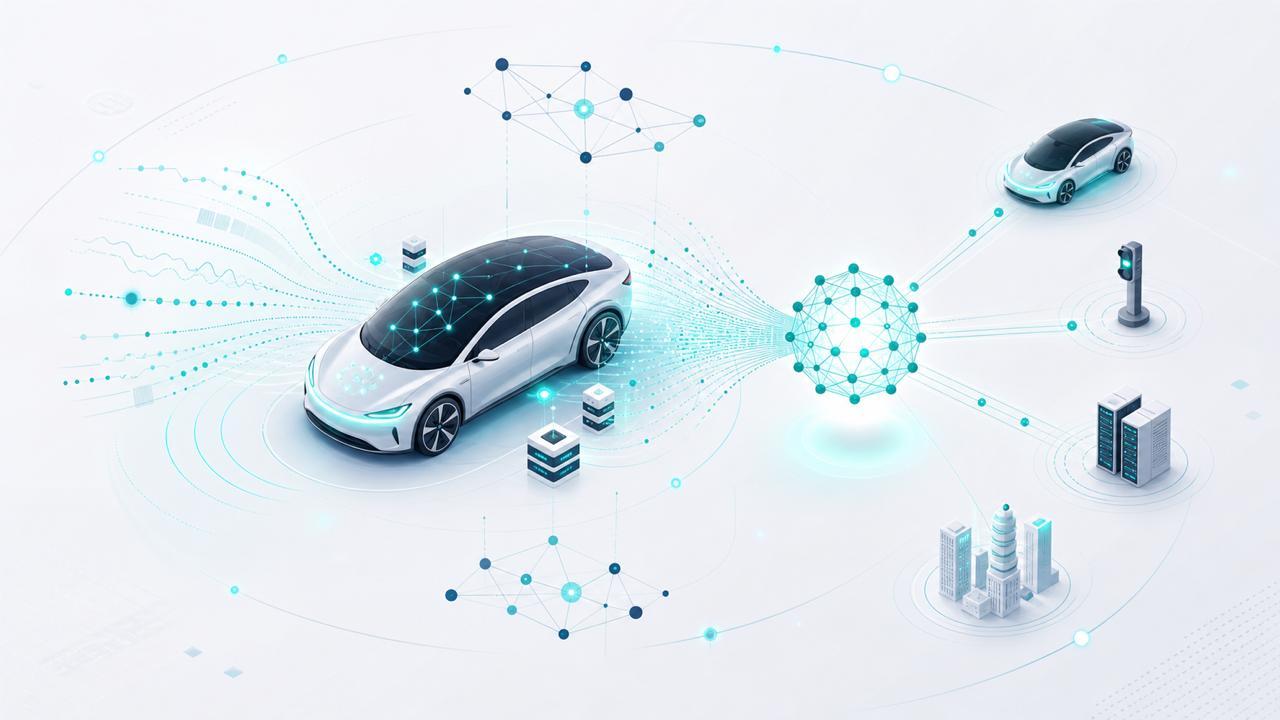
Every car constantly generates gigabytes of telemetry: engine speed, brake pressure, coolant temperature and dozens of other parameters. Transmitting all of it over a wireless network in V2X (Vehicle-to-Everything) systems places an enormous load on the communication channel. How can that load be reduced by orders of magnitude without losing the meaning of the data?
This is the problem solved by Car2Vec, our new framework based on contrastive self-supervised learning.
How it works. Instead of transmitting a stream of raw data, the on-board device compresses the entire telemetry stream directly in the vehicle into a compact vector of 40 numbers — a semantic description of the car's state. It is this vector that is sent onwards: to other vehicles, to traffic lights, to servers.
What the experiments showed:
a GNN-based model learned to separate trips into clusters in the latent space without any labelling;
clusters by fuel grade and engine oil viscosity emerged as well, although the model was never explicitly trained for this;
inference latency on a mobile processor with an NPU is under 1 ms, which makes the system suitable for real-time operation.
The approach reduces the wireless load by orders of magnitude compared with transmitting raw telemetry. Next we plan to test it on a fleet of more than 100 vehicles and to integrate it with cooperative driving tasks.
The paper was presented at ACM MobiCom '25 in Hong Kong.