IHIE: physics meets deep learning in industrial equipment monitoring
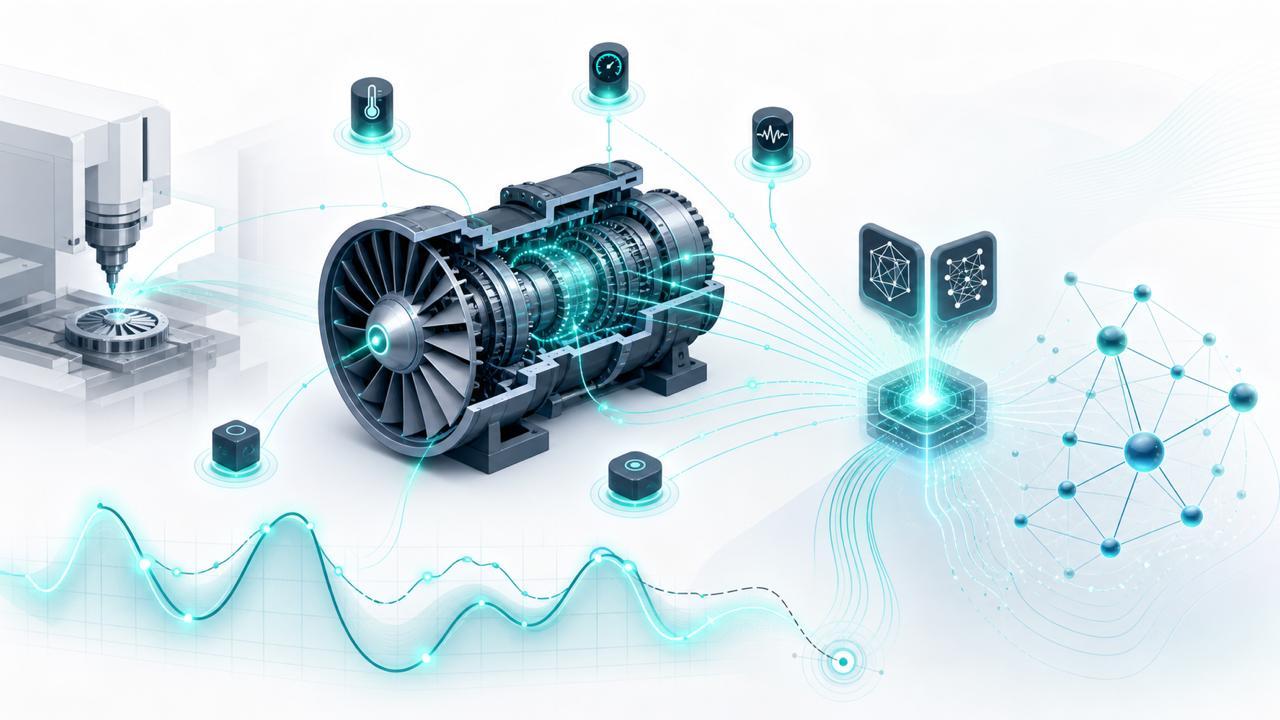
How do you know that a turbine, a machine tool or an engine is about to fail — before it actually does? Existing deep learning models for monitoring equipment wear usually estimate a single degradation characteristic, ignoring the physical principles that describe how machinery really ages.
Our researchers have presented a new approach and a model, IHIE (Industrial Health Index Extraction), for monitoring the condition of industrial equipment, combining sensor data with physical degradation equations.
Neural networks usually force the latent representation of a device towards one specific characteristic — for example, remaining useful life alone. We took a different route: the system simultaneously learns to predict several condition indicators and cross-checks them against each other. This works as a cross-validation, and as a result the model hallucinates unrealistic wear scenarios less often and its decisions become easier to explain.
The model was tested on two benchmark industrial datasets from NASA:
NASA C-MAPSS (predicting the remaining useful life of turbofan engines): IHIE outperformed all modern counterparts (GNMR, RVE, DSFormer, MSTCN and others) by RMSE on all four subsets of the dataset;
NASA Milling (predicting cutter wear): RMSE = 0.0056, noticeably better than competitors (LSTM-based: 0.0148, TAKELM: 0.0134);
the model contains only 5.1M parameters and runs at about 14 ms per inference on a V100 GPU.
The system can be deployed for monitoring aircraft engines, machine tools and any industrial system with sensors — from predictive maintenance to early anomaly detection. For those working with industrial AI or time series analysis, we are, as always, open to collaboration.